For the first time in its history, Light Asia leaves Asia. The 2026 edition arrives at one of the world's most extraordinary sites — the Archaeological Park of Pompeii.
Since its founding, Light Asia has established itself as Asia's most significant platform for the intersection of lighting design, architecture, and academic research. The annual forum brings together international lighting designers, professors, and students in a format that is both rigorous and open — equal parts forum, workshop, and cultural encounter.
The 2026 edition breaks new ground. For the first time, Light Asia crosses a continent. The Archaeological Park of Pompeii — a UNESCO World Heritage Site and one of the world's most studied ancient environments — becomes the setting for a dialogue about light, history, space, and human experience.
This is not a trade fair. It is not a conference in the conventional sense. It is a concentrated, intensive encounter between some of the world's most thoughtful practitioners of light, on a site that has been shaped by light — natural and artificial — for two millennia.
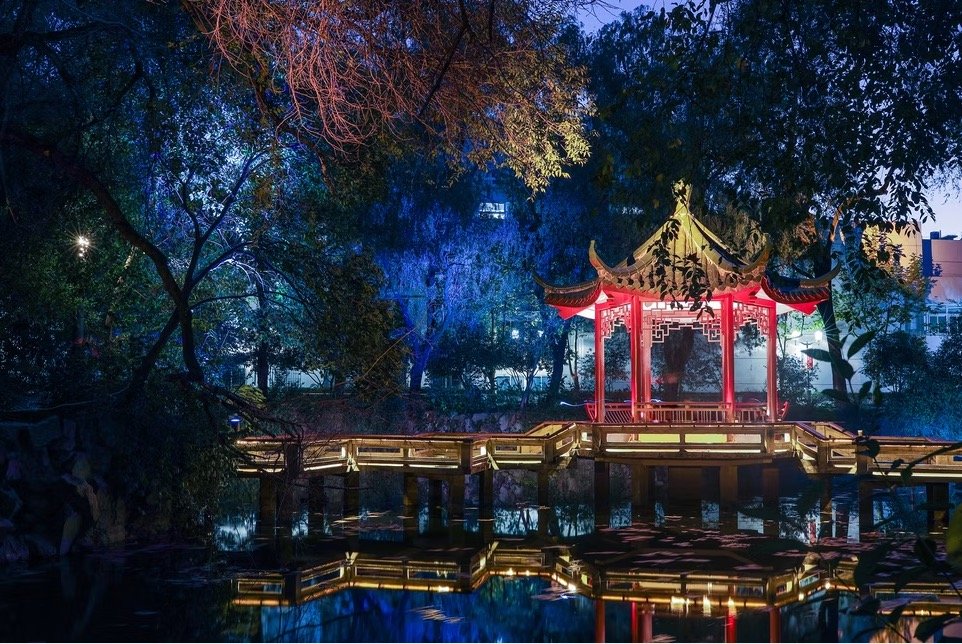
Light Asia 2019 — Shanghai, China. Lighting installation by Metis Marinella at Gucun Park.
Light Asia was founded by KKDC with a clear, long-term mandate: to contribute to the global lighting design sector without commercial boundary or profit motive. It operates as a Non-Profit Body Corporate — a legal structure that matches its philosophical one.
The idea grew from a shared conviction among a loosely organised group of lighting specialists: that the most meaningful contribution professionals can make to their field is the altruistic gift of knowledge and time. Every edition of Light Asia is built on voluntary participation — designers who give their expertise freely, students who engage seriously, institutions who open their doors.
This is not a platform for brands to demonstrate products. It is a platform for people to practise the discipline of lighting design in challenging, meaningful, real-world environments — guided by some of the world's most respected practitioners.
The academic programme is led by two full professors from the Università degli Studi Federico II di Napoli — one of Italy's oldest and most prestigious universities, founded in 1224. Their research unites architectural lighting science, human visual perception, and heritage conservation.
The 2026 programme places five internationally recognised lighting designers in direct dialogue with 25 architecture and engineering students from Federico II. The working format — intensive, site-specific, and collaborative — is what defines the Light Asia method.
This is not a lecture series. Designers and students work together, on-site, developing real lighting proposals for real spaces within the Archaeological Park. The proximity to the ancient environment is intentional — Pompeii is itself a document of how humans have always shaped space with light.
KKDC founded Light Asia as a Non-Profit Body Corporate with a mandate that has never wavered: to give the global lighting design community a platform for exchange that carries no commercial agenda is not a marketing exercise. It reflects something central to who we are as a brand: the belief that design culture is built through exchange, not export.
We are a Korean brand with deep Chinese manufacturing intelligence and an Italian design identity. Cross-cultural dialogue is not a tagline for us — it is the mechanism by which KIT Concept was built. Supporting Light Asia at Pompeii is a natural extension of that belief.
We are also proud that the 2026 edition is hosted in Italy — the country that has shaped our aesthetic identity more than any other. Bringing Light Asia to Pompeii feels like a conversation long overdue.
For programme information, participation enquiries, or press, visit the official Light Asia website or contact us directly through KIT Concept.